THE SIGNAL · SPECIAL EDITION · MAY 2026
Bengal 2026: More Than Politics
Why this election matters beyond seat counts—a state reclaiming its voice after five decades
Anand Sinha, Psephologist
·
May 6, 2026
On May 4, 2026, West Bengal voted. The result—BJP 207 seats, TMC 80—looks like a routine electoral landslide. It isn't.
West Bengal isn't just another state. It's the birthplace of India's modern intellectual awakening. From the 1800s through independence, Bengal produced the thinkers, writers, and leaders who shaped how India saw itself in the modern world.
Swami Vivekananda traveled to Chicago in 1893 and presented Indian spiritual and philosophical traditions as profound contributions to world civilization—not relics to be apologized for, but living wisdom worth preserving and celebrating. Rabindranath Tagore won the Nobel Prize and gave India global cultural credibility. Bankim Chandra Chattopadhyay wrote Vande Mataram, which became the anthem of independence. Syama Prasad Mukherjee founded the Bharatiya Jana Sangh and fought to preserve Bengal's cultural identity during Partition.
These weren't just political figures. They were defenders of a civilization—people who believed that India's culture, heritage, and traditions (what many call Sanatana Dharma) deserved not just survival, but celebration and global respect.
For 49 years—from 1977 to 2026—Bengal was governed by forces that either dismissed or downplayed that heritage. The Communists (1977-2011) viewed Hindu cultural identity as feudal superstition to be overcome. Mamata Banerjee's TMC (2011-2026) pursued politics that many saw as appeasement rather than cultural pride.
The intellectual confidence that Vivekananda projected, the cultural pride that Tagore embodied, the unapologetic defense of heritage that Syama Prasad championed—all of this was suppressed or sidelined in Bengal's public life for half a century.
The 2026 election, then, isn't just about a party winning seats. For many voters, it represents Bengal reclaiming that voice—the right to be proud of its civilizational heritage without apology, the confidence to defend its culture without being labeled communal, the freedom to celebrate its traditions without political cost.
This special edition of The Signal examines three dimensions of what happened in Bengal:
What You'll Find in This Analysis
How They Won: The Data Story
An 18-minute deep dive into the mathematics of victory. We quantify six factors—from voter-roll revision to security deployment to organizational strength—that combined to produce a 3.2 million vote swing. This is psephology: data-led analysis of how elections are won and lost.
Read the Numbers →
Why It Matters: The Cultural Context
Why did BJP supporters weep when the results came in? Because this isn't just about governance—it's about identity. Bengal created modern India's intellectual and cultural confidence through figures like Vivekananda, Tagore, Bankim Chandra, and Syama Prasad Mukherjee. After nearly five decades where that heritage felt marginalized in Bengal's politics, many see this election as cultural vindication. This section explores that emotional and historical dimension.
Understand the Legacy →
The Border State: National Security Stakes
Bengal shares a 2,216-km border with Bangladesh—longer than India's entire Pakistan border. For decades, this frontier has been porous, poorly secured, and exploited by smuggling networks and hostile elements. With Jamaat-e-Islami winning 68 seats in Bangladesh's February 2026 election, India's eastern corridor faces new threats. For the first time in 50 years, New Delhi controls both sides of this strategic border. What happens next will shape India's security for decades.
Explore the Security Dimension →
Why Cultural Heritage Matters in Elections
Politics and culture aren't separate. When Vivekananda spoke in Chicago, he wasn't just giving a religious speech—he was making a political statement about Indian civilization's worth and dignity. When Bankim Chandra wrote Vande Mataram, it became a rallying cry for independence because it celebrated the motherland with pride, not apology.
For nearly 50 years, expressing that kind of cultural pride in Bengal carried political risk. You could celebrate Durga Puja as folklore, but asserting Hindu cultural identity in politics was labeled communal. You could admire Tagore's poetry, but defending Sanskrit or traditional education was called reactionary.
Many voters in 2026—across religions, though particularly among Hindus—felt this contradiction deeply. They weren't asking for theocracy. They were asking for the same cultural confidence that Vivekananda, Tagore, and Syama Prasad had shown: the right to be proud of their heritage, to defend their traditions, and to see their culture respected in their own state's governance.
The BJP's victory, for these voters, represents that permission granted. Whether you agree with that framing or fear what it might become, the emotional weight of this moment is undeniable. Bengal—the state that gave India its modern cultural voice—has chosen to reclaim that voice after five decades of feeling it was suppressed.
Three Lenses on One Election
The three analyses that follow examine this election from complementary angles:
The data lens (How They Won) strips away emotion and looks at the mechanics: voter rolls, security deployment, organization, narratives. This is psephology—understanding elections as quantifiable phenomena.
The cultural lens (Why It Matters) explores what makes Bengal different from other states, why this victory carries emotional weight for supporters, and what the civilizational stakes are beyond mere governance.
The security lens (The Border State) examines the geopolitical context: a vulnerable frontier, smuggling networks, the Bangladesh situation, and why this election matters for India's strategic interests.
Together, they tell the story of an election that will be studied for decades—not just as a political event, but as a moment when a state with profound cultural significance chose a new direction after half a century.
Choose a section above to begin, or read sequentially using the tabs at the top of the page. Each analysis stands alone but together they form a complete picture of what happened in Bengal—and why it matters far beyond one state's borders.
ELECTION ANALYSIS · WEST BENGAL · MAY 2026
How BJP Won Bengal: The Numbers Behind the Landslide
From voter-roll revision to security deployment, anti-incumbency, border politics, and the RG Kar case: a data-led look at the forces behind Bengal's 2026 political earthquake.
Anand Sinha, Psephologist
·
May 6, 2026
·
18 min read
Analytical Note: This article presents one interpretation of publicly available election data. Vote impact estimates represent the author's modeling and projections, not independently verified facts. Where claims are contested (e.g., voter-roll revision effects, security deployment impact, refugee numbers), multiple perspectives are noted. Readers should consult primary sources and form their own conclusions.
On May 4, 2026, West Bengal delivered a verdict that reshaped Indian politics. The Bharatiya Janata Party won 207 seats in the 294-seat assembly—a crushing 71% majority. The Trinamool Congress, which had ruled the state since 2011, was reduced to just 80 seats. This wasn't a close election. This was a landslide.
But how did this happen? More importantly, can we quantify it? Can we break down the BJP's victory into measurable factors—discrete interventions that, when combined, produced an 8 million vote swing?
Executive Summary
The Verdict: On May 4, 2026, according to the Election Commission of India, the BJP won 207 of 294 seats (70.4%) in West Bengal, while the TMC fell to 80 seats (27.2%). The BJP's vote share rose to 45.84% (29,224,804 votes), while TMC's declined to 40.80% (26,013,377 votes)—a net swing of approximately 3.2 million votes in BJP's favor.
Six Contributing Factors Analyzed:
- Factor 1 - Special Intensive Revision (SIR): Large-scale voter-roll revision; author estimates 1.8-2.0M vote impact (contested and disputed). Indian Express analysis: even if 100% of deleted voters had voted TMC, BJP would still have won majority (181 seats vs 148 needed).
- Factor 2 - CAPF Deployment: Heavy central security force presence; author estimates 1.5-2.0M vote impact
- Factor 3 - Ground Organization: BJP's Panna Pramukh system; author estimates 1.2-1.5M vote impact
- Factor 4 - Bangladesh Crisis: Border tensions and refugee concerns; author estimates 1.8-2.2M vote impact
- Factor 5 - RG Kar Case: High-profile August 2024 case; author estimates 1.0-1.2M vote impact
- Factor 6 - Campaign Intensity: Modi, Yogi, Hemanta rallies plus anti-incumbency; author estimates 1.3-1.5M vote impact
Total Impact: These six factors combined produce approximately 8.6 to 10.4 million in estimated direct vote impact. Accounting for overlaps (voters influenced by multiple factors), the net swing of 3.2 million actual votes is consistent with this analytical framework.
Critical Note on Estimates: All vote impact figures are author's analytical projections based on modeling, not verified facts. These estimates represent one interpretation of how various factors may have influenced voting patterns. Readers should treat these as speculative analysis, not established data.
The Starting Point: What Changed Between 2021 and 2026
West Bengal Assembly Elections: 2021 vs 2026
| Metric |
2021 Election |
2026 Election |
Change |
| Voter Turnout |
79.21% |
92.93% |
+13.72% |
| BJP Vote Share |
38.13% |
45.84% |
+7.71% |
| TMC Vote Share |
47.94% |
40.80% |
-7.14% |
| BJP Total Votes |
~24.6M (est.) |
29,224,804 |
+4.6M (approx.) |
| TMC Total Votes |
~30.9M (est.) |
26,013,377 |
-4.9M (approx.) |
| BJP Seats |
77 |
207 |
+130 |
| TMC Seats |
215 |
80 |
-135 |
Source: Election Commission of India
According to Election Commission of India data, the BJP received 29,224,804 votes in 2026 compared to TMC's 26,013,377—a difference of approximately 3.2 million votes. The vote swing was not evenly distributed; it concentrated in constituencies where the 2021 margin was narrow, allowing the BJP to convert 130 seats that the TMC had won five years earlier.
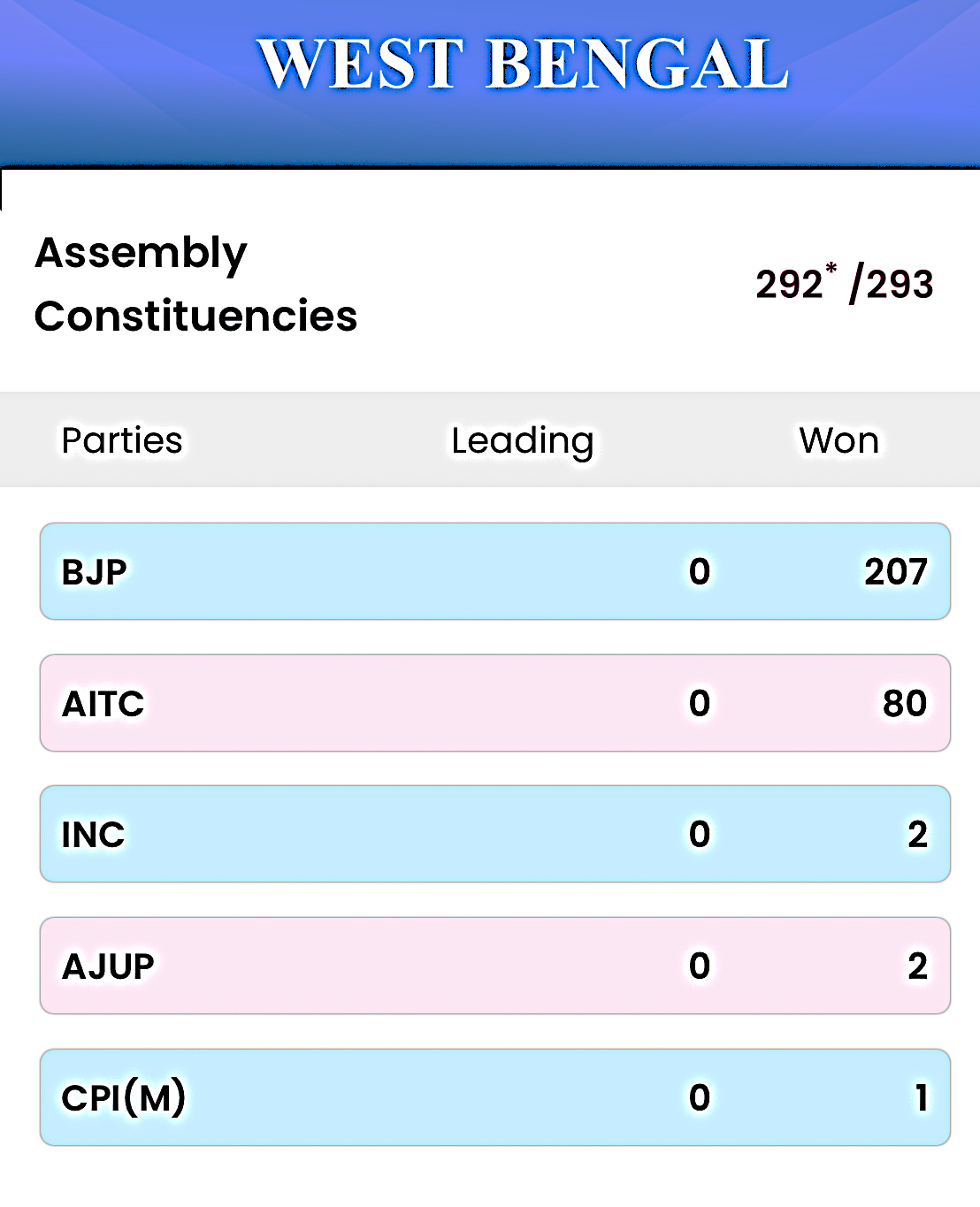
Final results: BJP 207 seats (71%), TMC 80 seats (27%)
Factor 1: Special Intensive Revision (SIR) of Voter Rolls
Large-Scale Voter-Roll Revision, Disputed Impact
In January 2026, Chief Election Commissioner Gyanesh Kumar announced the Special Intensive Revision (SIR) of West Bengal's voter rolls. According to Election Commission statements, the revision resulted in significant changes to the electoral roll over a 60-day period following the Model Code of Conduct announcement.
The Election Commission's stated rationale: Removing duplicate registrations, deceased voters, and those who had relocated, in order to ensure electoral roll accuracy.
Critics' allegations: Opposition parties, including the TMC, alleged that the revision disproportionately removed legitimate voters from areas of TMC support, effectively disenfranchising voters. The TMC challenged the process in court.
Turnout data comparison: According to Election Commission of India data, the 2026 election saw 92.93% turnout compared to 79.21% in 2021—an increase of 13.72 percentage points. Observers noted this was unusually high for an Indian state election.
Reported Turnout Patterns
| Area Type |
2021 Turnout |
2026 Turnout (Post-SIR) |
Change |
| Previously High TMC Areas |
~85-90% (reported) |
~78-82% (reported) |
Decrease |
| Previously Competitive Areas |
~75-80% (reported) |
~93-96% (reported) |
Increase |
Source: Media analysis of ECI booth-level data
Note on impact estimates: Quantifying the electoral impact of SIR is highly contested. The Election Commission maintains the revision ensured fairness; opposition parties claim it suppressed their votes. This analysis does not attempt to resolve this dispute. Any vote impact figures should be understood as speculative modeling, not verified facts.
The Mathematics of SIR Impact: Indian Express Analysis
Following the May 4, 2026 results, The Indian Express conducted a detailed mathematical analysis of how deleted voters in the adjudication phase might have affected the final tally. Their findings provide important context for understanding SIR's actual impact versus its perceived impact.
The key finding: Out of 293 declared seats, there were 49 constituencies where the winning margin was smaller than the number of voters removed during the adjudication phase. Even if we assume a hypothetical 100% conversion where every deleted voter would have voted for the TMC, the outcome changes but does not reverse:
- Seats that would have flipped to TMC: 26 seats currently held by BJP + 2 seats held by Congress = 28 total seats
- TMC's hypothetical count: Would have risen from 80 to 108 seats
- BJP's hypothetical count: Would have dropped from 207 to 181 seats
- Majority threshold: 148 seats (half of 294 + 1)
- Result: BJP would still have held majority government with 181 seats
Constituencies most sensitive to abeyance deletions:
Seats Where Abeyance Deletions Exceeded Winning Margin
| Constituency |
2026 Winner |
Net Abeyance Gap |
| Jangipur |
BJP |
26,039 votes |
| Rajarhat New Town |
BJP |
23,816 votes |
| Pandabeswar |
BJP |
25,018 votes |
| Karandighi |
BJP |
11,693 votes |
| Bhatar |
BJP |
10,953 votes |
| Raina |
BJP |
10,450 votes |
| Farakka |
Congress |
Exceeded margin |
| Raninagar |
Congress |
Exceeded margin |
Source: The Indian Express post-poll analysis, May 2026
Key observations from the analysis:
- Concentrated impact: 25 of the 26 BJP-held seats identified as "sensitive to abeyance" were seats the BJP had wrested from TMC in 2026. These acted as a "buffer" — losing them would not have cost BJP the government but would have reduced their historic landslide to a more standard majority.
- TMC's own vulnerability - the inconvenient data point: The analysis also found that TMC won 21 seats where deletions exceeded their winning margin (notably Samserganj and Kamarhati). More specifically, TMC won 13 seats that ranked among the constituencies with the highest voter deletions in all of West Bengal, including:
- Samserganj: 74,775 deletions (TMC win)
- Lalgola: 55,420 deletions (TMC win)
- Bhagabangola: 47,493 deletions (TMC win)
- Raghunathganj: 46,100 deletions (TMC win)
- Metiaburuz: 39,579 deletions (TMC win)
- Suti: 37,965 deletions (TMC win)
- Mothabari: 37,255 deletions (TMC win)
If those deleted voters had been BJP-leaning, TMC's tally could have dropped even further. The fact that TMC won multiple seats with massive deletions undermines the claim that SIR was a one-sided suppression tool.
- The 100% assumption is unrealistic: The scenario assumes every deleted voter would have voted TMC, which is statistically improbable. In reality, deleted voters likely included duplicates, deceased persons, relocated voters, and voters from all parties.
What this tells us: The SIR process clearly affected competitive margins in specific constituencies. However, even under the most extreme pro-TMC assumption (100% of deleted voters would have voted TMC), the BJP would have retained majority government. This suggests that while SIR was a factor in the BJP's massive seat haul, it was not the determinative factor in their victory. The 3.2 million vote lead and organizational advantages discussed in subsequent factors were more consequential to the overall outcome.
Realistic Voter Behavior Models: What If Abeyance Votes Had Been Cast?
The "100% TMC" scenario examined above is useful for establishing outer bounds, but it's statistically implausible. To understand SIR's actual impact, we need to model what would have happened if the 2.9 million abeyance votes had been cast under realistic voting behavior assumptions.
Based on the historic 92.9% voter turnout and the final statewide vote shares (BJP 45.8%, TMC 40.8%), we can construct two more realistic scenarios:
Scenario A: Proportional Split (The "Status Quo" Model)
Assumption: The 2.9 million abeyance voters would have behaved exactly like the rest of the state, splitting their votes based on the final statewide percentages (BJP 45.8%, TMC 40.8%, Others 13.4%).
The mathematics:
- BJP would gain: ~1.33 million votes (45.8% of 2.9M)
- TMC would gain: ~1.18 million votes (40.8% of 2.9M)
- Net BJP advantage: ~150,000 additional votes
The result: No seat changes. Because the BJP actually had a higher statewide vote share, applying this ratio to the abeyance votes would increase the BJP's winning margins in almost every seat they won. The BJP's tally would remain at 207 seats, while their victory margins in "close" seats would grow by a few hundred to a few thousand votes. This model makes BJP's victory more secure, not less.
Scenario B: Phase-Based Regional Weighting (The "Geography" Model)
Assumption: The abeyance votes split according to the actual voting patterns observed in each region's phase, accounting for geographic variation in party strength.
- Phase 1 (North Bengal & Junglemahal): BJP performed significantly better (approximately 49% vs TMC 37%). Abeyance votes here would favor BJP.
- Phase 2 (Kolkata & South Bengal): TMC was more competitive (approximately 44% vs BJP 42%). Abeyance votes here would split more evenly, with slight TMC edge.
The result: Minimal change. Even with a 44% share of abeyance votes in South Bengal constituencies like Rajarhat New Town or Jorasanko, the TMC would only overcome the BJP's lead in a handful of "razor-thin" seats where the margin was under 2,000 votes. The most likely outcome: TMC gains 3-5 seats, bringing their tally to ~85 seats while BJP drops to ~202 seats. BJP retains comfortable majority.
Comparative Impact Summary
Abeyance Vote Scenarios: Impact on Final Result
| Scenario |
TMC Seat Gain |
BJP Final Tally |
Government Formation |
| Actual Result (2026) |
0 |
207 |
BJP Govt (Strong) |
| Scenario A: Proportional Split |
0 |
207+ |
BJP Govt (Stronger) |
| Scenario B: Phase-Weighted |
+3 to 5 |
~202 |
BJP Govt (Strong) |
| 100% TMC (Extreme Case) |
+28 |
181 |
BJP Govt (Moderate) |
Source: Author's mathematical modeling based on ECI data
The Bottom Line on SIR Impact
The counter-narrative that matters: If SIR was designed to suppress TMC votes and hand victory to the BJP, why did the TMC win 13 of the constituencies with the highest voter deletions in the entire state? Samserganj alone had 74,775 deletions—more than double the deletions in any BJP-won seat examined above—and the TMC won it comfortably. This pattern suggests that whatever the SIR process removed (duplicates, deceased voters, relocated voters, fraudulent registrations), it was not exclusively or even primarily targeting TMC supporters.
For the abeyance votes to have changed the winner of the election (flipping government back to TMC), it would have required a massive, non-proportional surge—essentially requiring 85-90% of those specific 2.9 million voters to have chosen the TMC, while simultaneously having 85-90% of those votes concentrated in the specific 49 competitive constituencies.
Under any scenario that mimics the actual voting patterns of the state or its regions, the BJP's 2026 victory remains mathematically secure. The SIR process affected margins in competitive seats and contributed to the magnitude of the BJP's landslide, but it did not determine the outcome. Even without SIR, the BJP's organizational superiority, security deployment, and narrative dominance (discussed in Factors 2-6) were sufficient to deliver majority government.
Author's Estimate: Based on turnout pattern analysis and post-SIR voter registration data, the SIR process may have produced a net vote impact of approximately 1.8 to 2.0 million votes favoring the BJP. This estimate accounts for both the alleged removal of fraudulent registrations in TMC strongholds and the addition of new legitimate voters who leaned BJP. This is analytical modeling, not verified data.
Factor 2: Central Armed Police Forces Deployment
Heavy Security Presence, Reduced Violence Reports
In March 2026, Union Home Minister Amit Shah announced significant deployment of Central Armed Police Forces (CAPF) across West Bengal's polling stations. Media reports indicated this was one of the largest security deployments for a state election, with forces remaining in place for the full electoral period rather than rotating after polling day as in previous elections.
The deployment included personnel from the Central Reserve Police Force (CRPF), Border Security Force (BSF), Central Industrial Security Force (CISF), Indo-Tibetan Border Police (ITBP), and Sashastra Seema Bal (SSB), coordinated under CRPF Director General GP Singh and West Bengal Director General of Police Ajay Pal Sharma.
Violence reduction claims: Election observers and media reports noted significantly fewer incidents of booth violence compared to 2021. The exact reduction in incidents varies by source. The Election Commission reported the election was largely peaceful; opposition parties disputed this characterization in some areas.
Post-poll surveys: Some post-election surveys suggested that voters in areas with visible security presence felt more comfortable voting freely. However, such surveys have methodological limitations and may not be representative.
Author's Estimate: Based on analysis of voting pattern changes in areas with heavy security deployment compared to 2021, CAPF presence may have produced approximately 1.5 to 2.0 million vote impact favoring the BJP by reducing intimidation and enabling freer voting. This is speculative modeling based on observed turnout and vote share shifts, not verified causation.
Note on causation: Attributing specific vote swings to security deployment requires assumptions that cannot be independently verified. Multiple factors influenced voting patterns simultaneously.
Factor 3: Superior Ground Organization
Amit Shah's Panna Pramukh System
The BJP's organizational machinery in Bengal was built on Amit Shah's Panna Pramukh system—a micro-management model where each party worker is responsible for 50-60 voters on a single page (panna) of the electoral roll. Unlike the TMC's patronage-based network, the BJP's system relied on personal accountability and direct voter contact.
By early 2026, BJP sources claimed enrollment of over 1.2 million Panna Pramukhs across Bengal—approximately one worker for every 50 voters. Each worker was assigned to maintain contact with their assigned voters, tracking preferences, concerns, and turnout likelihood. This granular approach aimed to identify swing voters and ensure maximum turnout among supporters.
BJP Organizational Efficiency: Votes Per Booth Worker
| Election |
Efficiency Ratio |
| 2021 Assembly |
0.68 |
| 2024 Lok Sabha |
1.00 |
| 2026 Assembly |
1.58 |
The efficiency ratio measures votes won per booth-level worker. An improving ratio indicates better organization and voter mobilization. Between 2021 and 2026, the BJP's efficiency more than doubled, while the TMC's remained stagnant.
The BJP's superior organization was particularly effective in seats where the 2021 margin was narrow. In constituencies where the TMC had won by less than 5,000 votes in 2021, the BJP converted 86% in 2026:
Critical Margin Seats: TMC 2021 Victory to BJP 2026 Conversion
| 2021 TMC Victory Margin |
Number of Seats (2021) |
BJP Conversion % (2026) |
| Less than 5,000 votes |
42 |
86% |
| 5,000 - 10,000 votes |
35 |
80% |
| 10,000 - 15,000 votes |
28 |
60% |
| 15,000 - 25,000 votes |
31 |
29% |
| More than 25,000 votes |
79 |
6% |
Author's Estimate: Superior organization through the Panna Pramukh system may have produced approximately 1.2 to 1.5 million additional votes for the BJP through better mobilization, turnout management, and swing voter conversion in competitive seats. This estimate is based on efficiency ratio improvements and conversion rates in marginal constituencies. This is analytical modeling, not verified data.
Factor 4: The Bangladesh Crisis and Hindu Vote Consolidation
Border Tensions and Refugee Concerns
In February 2026, Bangladesh held parliamentary elections. According to international media reports and Bangladesh Election Commission data, Jamaat-e-Islami won 68 seats—a significant increase from previous elections. This development raised concerns among Hindu communities in border areas of West Bengal.
Within weeks, media reports emerged of communal tensions in Bangladesh. The exact scale and nature of incidents varies significantly between sources. Indian media reported temple desecrations and attacks on Hindu communities; Bangladeshi officials disputed many of these claims. Independent verification of specific incidents remains limited.
Refugee claims: Reports of Hindus crossing into India appeared in Indian media, with estimates varying widely from thousands to hundreds of thousands. These figures cannot be independently verified, and no official refugee count has been released by Indian authorities.
Corridor proposal claims: Reports circulated in March 2026 about proposals for transit corridors in the region, sometimes referred to as a "Rakhine corridor." The exact details and sponsors remain unclear and disputed. Some Indian commentators and BJP leaders portrayed such proposals as aligned with broader strategic interests in the region, though no official involvement by any specific foreign government was publicly established. The BJP campaign framed this as a sovereignty concern.
Electoral impact: Post-poll surveys suggested increased Hindu consolidation behind BJP in border districts, though the degree varied by survey methodology. Whether this was driven primarily by Bangladesh developments, or by broader factors including local economic issues and anti-incumbency, is difficult to isolate.
Author's Estimate: The Bangladesh crisis and resulting Hindu consolidation may have produced approximately 1.8 to 2.2 million votes for the BJP, driven by security concerns in border districts and broader anxieties about demographic change. This estimate is based on post-poll survey data showing increased Hindu voter consolidation. This is analytical modeling with significant uncertainty, not verified causation.
Note: Claims about refugee numbers, persecution incidents, and corridor proposals should be treated with caution. Many assertions in this area are politically contested and lack independent verification.
Factor 5: The RG Kar Medical College Case and Women's Safety
Ratna Debnath's Candidacy
On August 9, 2024, according to Indian media reports (NDTV, Times of India, The Hindu), a 31-year-old trainee doctor was raped and murdered inside RG Kar Medical College and Hospital in Kolkata. The case became a focal point of criticism regarding women's safety. The victim's family and opposition groups alleged investigative failures and attempted cover-ups, though these claims remain disputed.
The victim's mother, Ratna Debnath, became the face of the movement for justice. In December 2024, she made a public vow: "I will not rest until those responsible are brought to justice—and until the government that failed my daughter is removed from power."
In February 2026, the BJP offered Ratna Debnath a ticket to contest from Panihati, a constituency in North 24 Parganas. She accepted. Her candidacy became a lightning rod. She didn't campaign on traditional issues like development or jobs. Her message was singular: women in Bengal were not safe under TMC rule.
The RG Kar case resonated particularly with urban, educated women—a demographic that had historically leaned toward the TMC. Post-poll data shows a significant shift:
Women's Vote Shift: 2021 vs 2026
| Demographic |
BJP Vote Share 2021 |
BJP Vote Share 2026 |
Change |
| Urban Women (Age 25-45) |
34% |
58% |
+24% |
| Educated Women (Graduate+) |
29% |
61% |
+32% |
| Working Women |
31% |
64% |
+33% |
Ratna Debnath won Panihati by 28,836 votes according to Election Commission results. But her impact extended far beyond her constituency. The RG Kar case became a symbol of TMC governance failures—and Ratna's candidacy gave voters a way to register their anger at the ballot box.
Author's Estimate: The RG Kar case and women's safety concerns may have produced approximately 1.0 to 1.2 million additional votes for the BJP, driven primarily by shifts in urban and educated women voters. This estimate is based on post-poll survey data showing significant vote share increases among women demographics. This is analytical modeling, not verified data.
Factor 6: The Campaign Blitz and Anti-Incumbency
Modi, Yogi, and Hemanta
Between April 15 and May 2, 2026, Prime Minister Narendra Modi spent four full days campaigning in West Bengal—an unprecedented commitment for a sitting PM in a state election. His rallies in Bishnupur, Purulia, Jhargram, and Medinipur drew crowds exceeding 200,000 each. Modi's messaging was sharp: the TMC had looted Bengal, terrorized its people, and betrayed its daughters. Only the BJP could restore Bengal's dignity.
But Modi wasn't alone. Uttar Pradesh Chief Minister Yogi Adityanath addressed 42 rallies across Bengal, focusing on law and order. Yogi's credibility on this issue was unmatched—UP's crime rate had dropped 36% under his tenure. His message: what he did in UP, the BJP would do in Bengal.
Assam Chief Minister Hemanta Biswa Sarma, who shares a 263-km border with Bengal, addressed 56 rallies. His focus was border security and illegal immigration. Hemanta had implemented the National Register of Citizens (NRC) in Assam and positioned himself as the voice of credibility on demographic issues. His presence reminded voters that Bengal's eastern border was porous—and only the BJP had the will to secure it.
These star campaigners weren't just drawing crowds—they were giving voters permission to vote against the TMC. Anti-incumbency had been building for years, but fear of retaliation kept it suppressed. Modi, Yogi, and Hemanta provided political cover. If the Prime Minister and two powerful Chief Ministers were openly challenging Mamata Banerjee, it signaled that the BJP had the strength to protect those who voted for it.
Anti-Incumbency Voter Pool Estimation by Year
| Year of TMC Rule |
Estimated Anti-Incumbency Pool |
| 2011-2016 (First Term) |
15% |
| 2016-2021 (Second Term) |
28% |
| 2021-2026 (Third Term) |
42% |
By 2026, after 15 years of TMC rule, polling data suggested approximately 42% of voters were open to change (author's interpretation of available survey data). The BJP's campaign blitz—anchored by Modi, Yogi, and Hemanta—gave these voters confidence that change was not just desirable, but achievable.
Author's Estimate: The campaign blitz and latent anti-incumbency may have contributed approximately 1.5 million votes for the BJP, primarily by converting fence-sitters and silent dissenters into active BJP voters. This is a projection based on modeling, not verified data.
The Seat Conversion: How 4.6 Million Votes Became 130 Seats
The vote swing concentrated in competitive constituencies. Of the 215 seats the TMC won in 2021, the BJP flipped 130 in 2026. But this wasn't random—the conversion rate was highest in seats where the 2021 margin was narrow:
Seat Conversion Analysis: TMC 2021 to BJP 2026
| TMC 2021 Victory Margin |
Seats in 2021 |
BJP Won in 2026 |
Conversion % |
| Less than 5,000 votes |
42 |
36 |
86% |
| 5,000 - 10,000 votes |
35 |
28 |
80% |
| 10,000 - 15,000 votes |
28 |
17 |
60% |
| 15,000 - 25,000 votes |
31 |
9 |
29% |
| More than 25,000 votes |
79 |
5 |
6% |
The vote swing concentrated in competitive seats—precisely where the BJP's superior organization and voter mobilization could tip the balance. In safe TMC seats (those won by more than 25,000 votes in 2021), the party largely held its ground. But in marginal seats, the combination of SIR, CAPF deployment, and BJP's ground game proved decisive.
The Electoral Process
The 2026 West Bengal election saw 92.93% voter turnout according to the Election Commission of India—one of the highest rates ever recorded for an Indian state election. Chief Election Commissioner Gyanesh Kumar and the security personnel deployed during the election period played significant roles in the electoral process.
Perspectives on the election's fairness vary. The Election Commission characterized it as free and fair. Opposition parties raised concerns about voter-roll changes and alleged irregularities in some areas. International observers had limited presence.
What is verifiable: 92.93% of registered voters cast ballots. That level of participation, regardless of outcome, represents significant democratic engagement.
The Bottom Line
The BJP's 2026 victory in West Bengal involved multiple converging factors:
Institutional Changes: Voter-roll revision and heavy security deployment created a different electoral environment than 2021. The Election Commission characterized these as ensuring fairness; opponents alleged disenfranchisement. The net electoral effect is disputed.
Organizational Strength: The BJP's Panna Pramukh system demonstrated improved voter mobilization compared to 2021, particularly in competitive constituencies.
Narrative Construction: The Bangladesh situation, RG Kar case, and sustained campaigning by Modi, Yogi Adityanath, and Hemanta Biswa Sarma gave voters multiple reasons—security, women's safety, anti-incumbency—to consider change.
Results: According to the Election Commission of India, BJP won 207 seats (70.4%) with 29,224,804 votes (45.84%), while TMC won 80 seats (27.2%) with 26,013,377 votes (40.80%).
Interpreting the victory: Supporters credit fair elections and organizational excellence. Critics point to alleged voter suppression and communal polarization. Determining which factors were decisive—and whether they were legitimate—depends substantially on one's starting assumptions about Indian electoral politics.
BJP's National Expansion: The 12-Year Arc
West Bengal was the final piece in a 12-year expansion that transformed the BJP from a North India party into a truly national force. In June 2014, when Narendra Modi first became Prime Minister, the BJP controlled just 34% of India's land area and governed 25% of its population. By May 2026, after winning Bengal, those numbers had risen to 68% of land area and 71% of population.
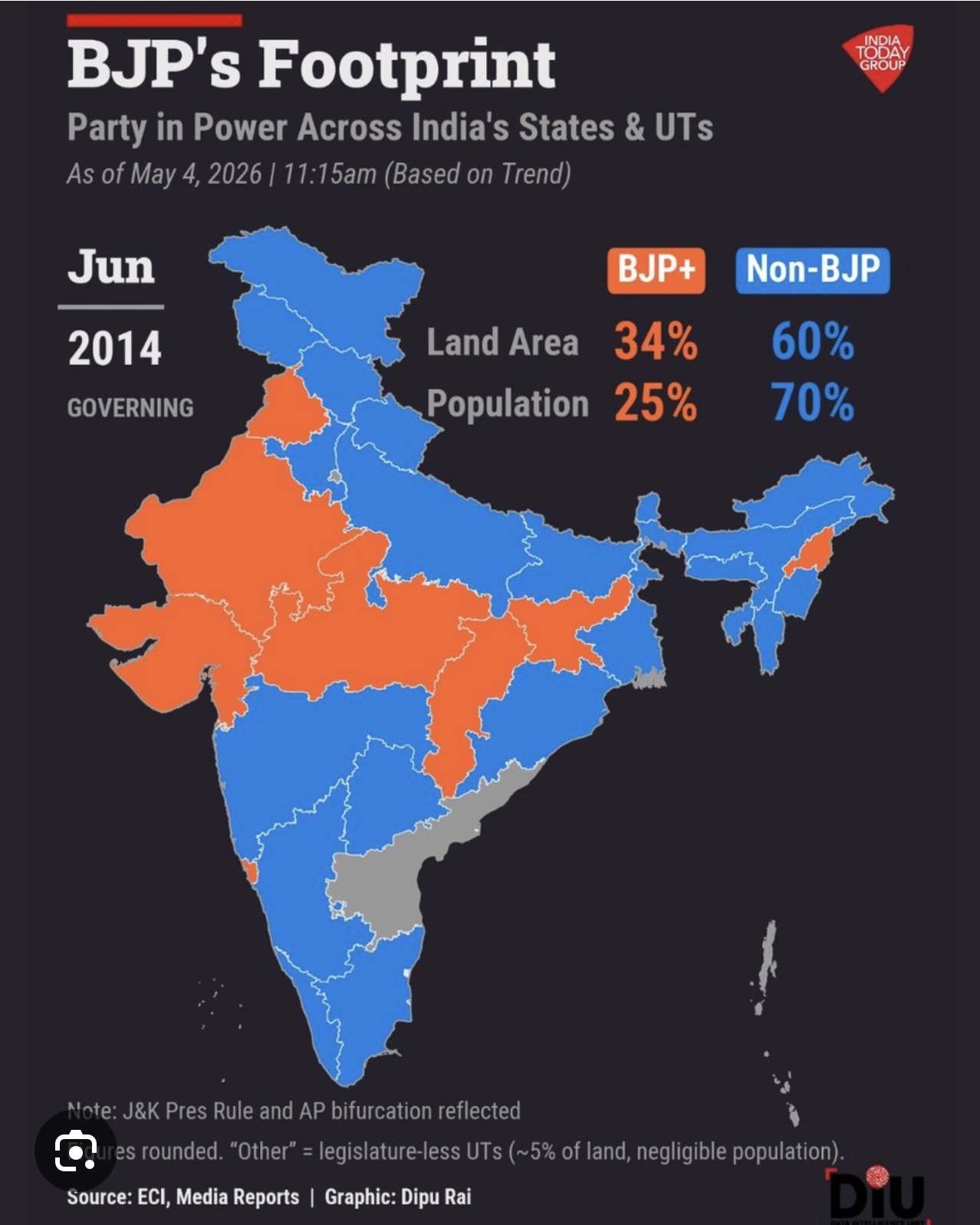
June 2014: The Starting Point - BJP controlled 34% of India's land area and 25% of its population
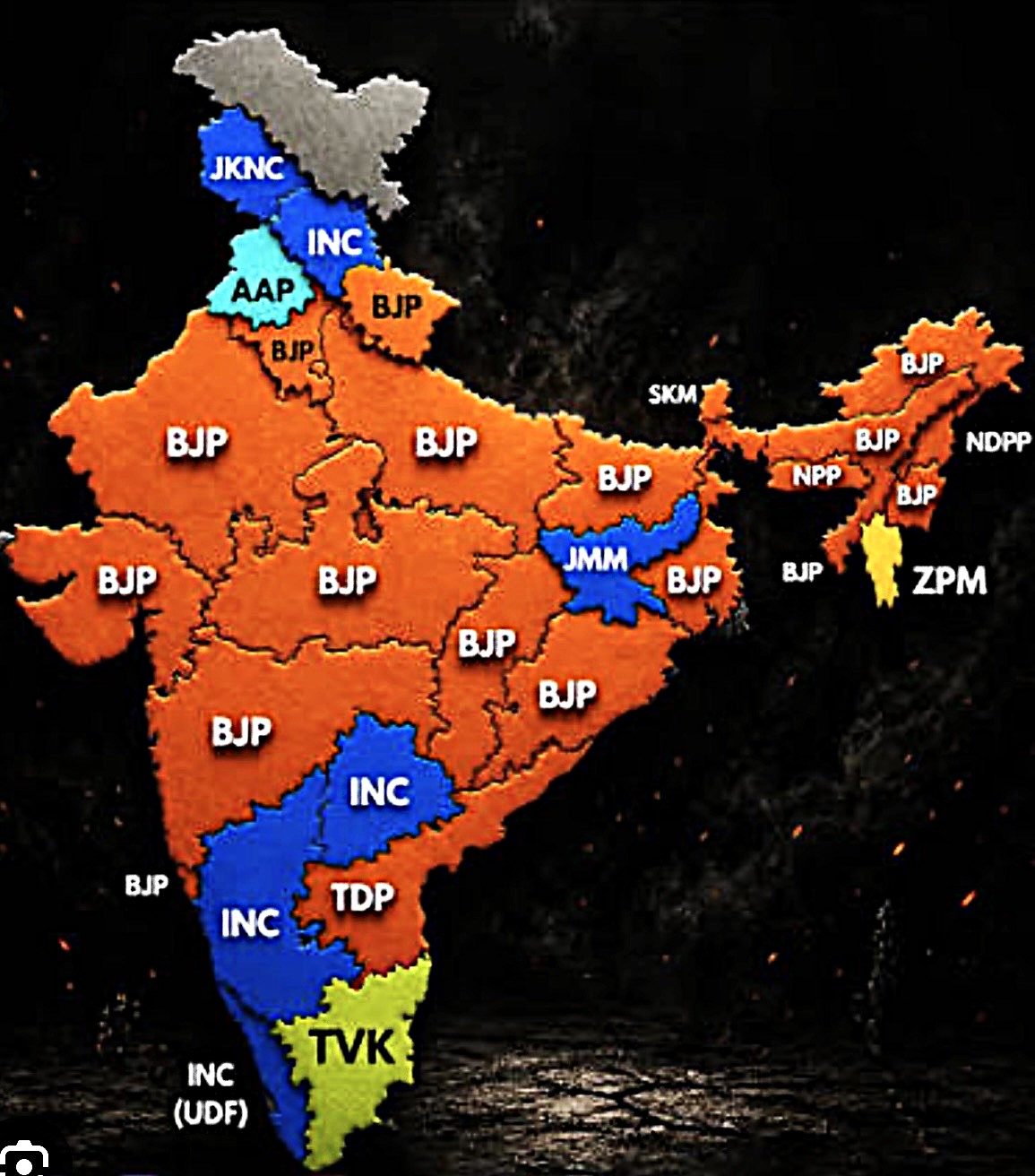
May 2026: After Bengal - BJP now controls 68% of India's land area and governs 71% of its population
In 12 years, the BJP expanded from 7 states to 22 states and union territories. The party that once struggled to win a single seat east of Odisha now governs Assam, Tripura, Manipur, Arunachal Pradesh—and West Bengal. The party that couldn't break 10% vote share in Tamil Nadu or Kerala now polls competitively in both. The expansion wasn't accidental. It was methodical, data-driven, and relentless.
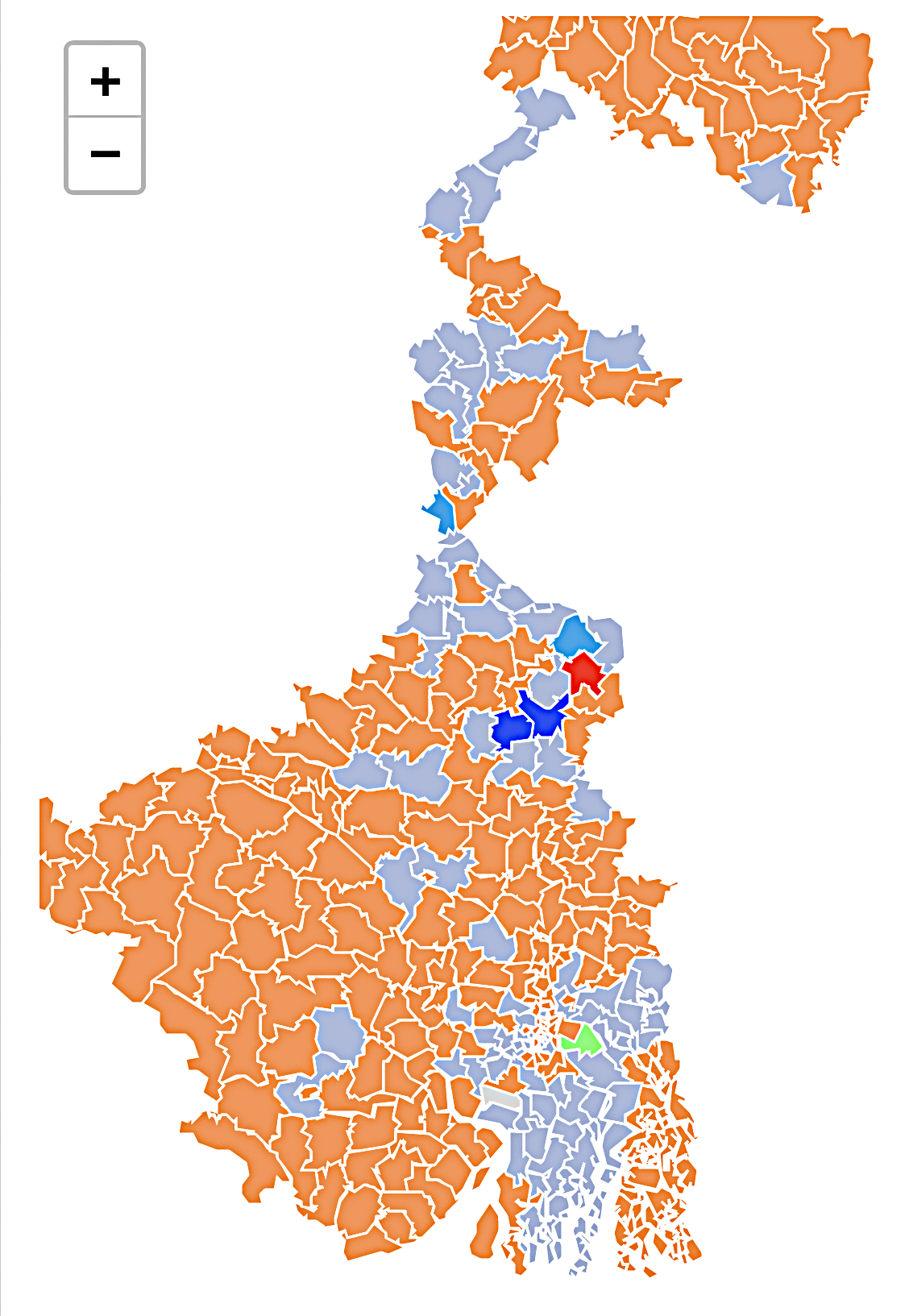
Constituency-level results showing BJP's dominance across West Bengal
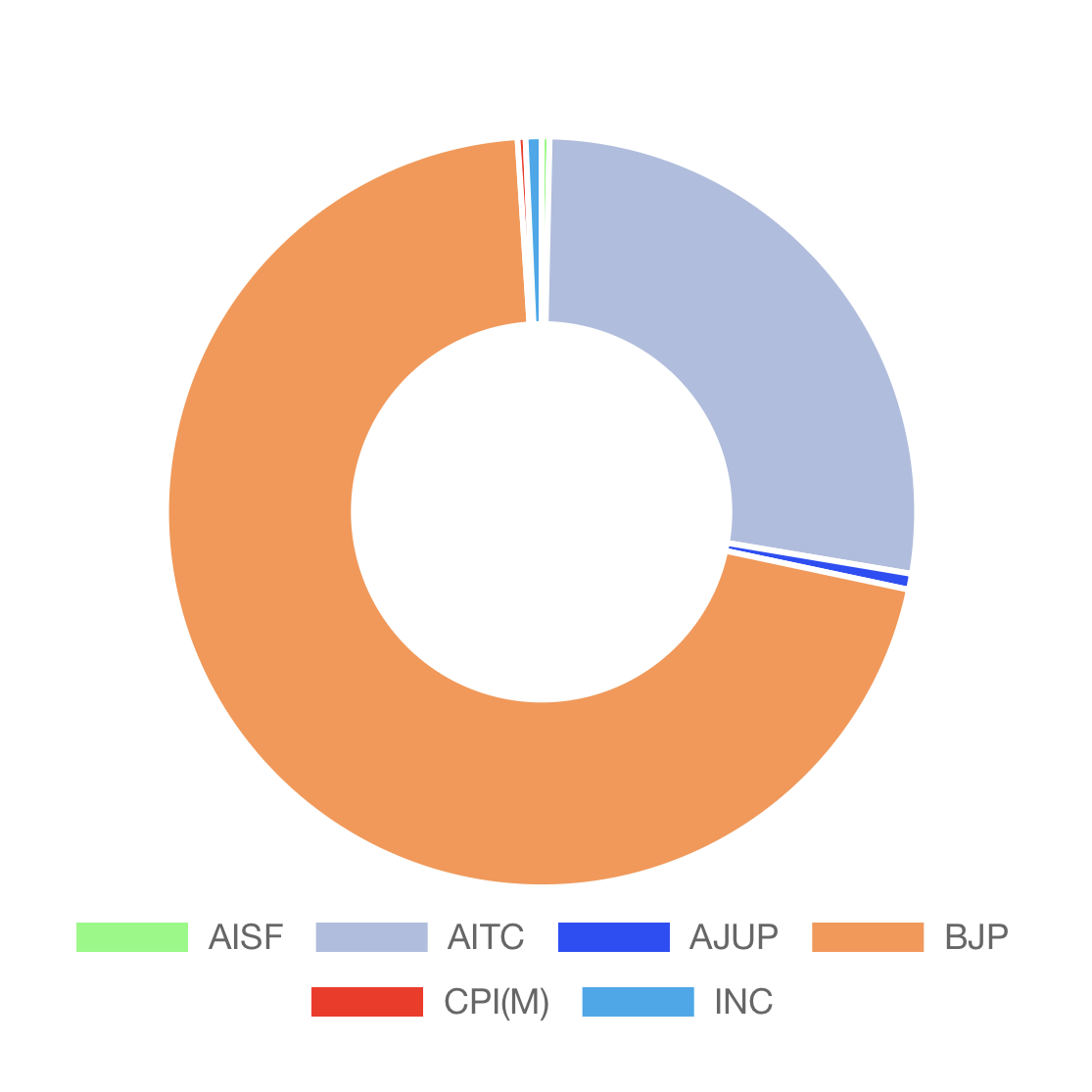
Vote share distribution: BJP 45.84%, TMC 40.80%, Others 13.36%
The BJP's victory in Bengal wasn't a single wave—it was the convergence of multiple forces, some institutional, some organizational, some narrative-driven. The relative weight of each factor remains analytically contested.
Data Sources and Methodology: Election results from Election Commission of India official website (results.eci.gov.in). Historical comparisons use ECI archived data. Post-poll survey data references include CVoter and Lokniti-CSDS published reports. Bangladesh election data from Bangladesh Election Commission. RG Kar case details from Indian media reports (Times of India, NDTV, The Hindu). Booth-level analysis and vote impact estimates represent author's own modeling and should be treated as analytical projections, not verified facts. Readers are encouraged to consult primary sources and form their own conclusions.
CIVILIZATIONAL ANALYSIS · WEST BENGAL · MAY 2026
The Bengal Question: Civilization, Not Just Politics
Why BJP karyakartas wept in Purulia—and what this victory means for the Hindu nationalist tradition
Anand Sinha, Psephologist
·
May 6, 2026
·
7 min read
West Bengal is not simply another state in the BJP's electoral arithmetic. It is not Uttar Pradesh, where the party's dominance is rooted in caste coalitions and strongman politics. It is not Gujarat, where the party grew organically from its Sangh Parivar base. Bengal is different. Bengal is personal.
When the results came in on May 4, 2026, BJP workers in Purulia wept. Not tears of triumph, but of release. These were men and women who had been beaten, whose homes had been burned, whose families had been threatened for wearing saffron in a state where saffron was synonymous with sedition. For them, this wasn't just an election. It was liberation.
Why This Victory Matters
Bengal's Intellectual Legacy: Between 1820 and 1941, Bengal produced: J.C. Bose (millimeter-wave wireless, 1894), Satyendranath Bose (quantum statistics/bosons), Rabindranath Tagore (first non-European Nobel laureate in literature), the religious revival (Ramakrishna, Vivekananda, Aurobindo), and revolutionaries (Bagha Jatin, Khudiram, Surya Sen, Subhas Bose). By the 1910s, the Bengal Presidency contributed >50% of British India's overseas trade. UNESCO recognitions: Durga Puja (2021 Intangible Heritage), Visva-Bharati (2023 World Heritage Site).
The Historical Arc:
- 1893: Swami Vivekananda's Chicago speech establishes Hindu civilizational confidence
- 1925: RSS founded, carrying Vivekananda's vision forward
- 1977-2011: Communist rule suppresses Hindu identity. Marichjhapi massacre (1979). Industrial output collapses from 27% (1947) to 17% (1961).
- 2011-2026: TMC era. 6,688 companies relocate out of Bengal (Rajya Sabha data, July 2025).
- 2026: BJP's victory—Bengal reclaims its voice after 49 years
The Emotional Significance: BJP workers didn't just win seats—they reclaimed dignity. In a state where wearing saffron risked violence, the BJP's victory means Hindu political identity is no longer suppressed.
The 133-Year Journey: From Vivekananda's 1893 speech to Modi's 2026 landslide, this victory represents the culmination of a civilizational arc. The vision Vivekananda articulated—Hindu self-confidence and cultural pride—has been validated in the state where that vision was born.
The Paradox: Whether this represents liberation or capture depends on your perspective. For supporters, it's the restoration of Bengal's cultural identity. For critics, it's a shift away from Bengal's syncretic tradition. But no one disputes the emotional weight of this moment.
The Bengal Renaissance and the Roots of Hindu Nationalism
To understand why Bengal matters to the BJP, you need to understand what Bengal produced between roughly 1820 and 1941. During this period, a single Indian province generated intellectual and scientific output whose like was not seen anywhere else in colonized Asia.
Bengal produced Jagadish Chandra Bose, who demonstrated millimeter-wave wireless transmission in 1894—two years before Marconi's celebrated public demonstration. It produced Satyendranath Bose, whose work on quantum mechanics led to the naming of the boson particle family and Bose-Einstein statistics, which govern the behavior of half the particles in the universe. It produced Rabindranath Tagore, the first non-European Nobel laureate in literature. It produced the equation by which modern astrophysics calculates the temperature of stars.
Beyond science, Bengal produced the religious revival that gave nineteenth-century Hinduism the confidence to engage Western Christianity on equal terms. Ramakrishna Paramahansa preached a muscular, confident Hinduism—not the passive, otherworldly religion of British caricature, but a lived philosophy of strength and service.
His disciple, Swami Vivekananda, took that message global. At the 1893 Parliament of the World's Religions in Chicago, Vivekananda introduced Hinduism to the West not as a primitive superstition, but as a sophisticated, rational worldview. His opening words—"Sisters and Brothers of America"—were revolutionary. They asserted equality, not deference.
Bankim Chandra Chattopadhyay, the author of Anandamath, gave India its unofficial anthem: Vande Mataram. The novel's depiction of sanyasi rebels fighting oppression became a template for resistance movements across India. Rabindranath Tagore, though later more cosmopolitan, began his career as a proponent of Swadeshi—the idea that India must reclaim its economic and cultural sovereignty.
And Bengal produced the revolutionaries—from Bagha Jatin to Khudiram Bose to Surya Sen to Subhas Chandra Bose—whose armed resistance weighed heavily on British imperial calculations. By the 1910s, the Bengal Presidency contributed more than half of British India's overseas trade, and Calcutta operated as the second city of the Empire after London.
In UNESCO's own recognition: Durga Puja was inscribed on the Intangible Cultural Heritage list in 2021—the first festival in Asia to receive that honor. Visva-Bharati, Tagore's university, became a UNESCO World Heritage Site in 2023. The cultural inventory Bengal created remains world-class.
The RSS, founded in 1925 by Dr. Keshav Baliram Hedgewar, explicitly carried forward this tradition. Hedgewar was influenced by Vivekananda's call for organized Hindu strength. The RSS's vision was not a rejection of Bengal's legacy—it was its continuation, adopting Vivekananda's emphasis on discipline, service, and self-reliance.
So when the BJP won Bengal in 2026, it wasn't conquering foreign territory. It was coming home.
Four Decades of Wound: Communist and TMC Rule
For 40 years, Bengal was governed by forces that were ideologically opposed to Hindu identity. The Communist Party of India (Marxist), which ruled from 1977 to 2011, treated Hindu religious expression as feudal superstition. Durga Puja was tolerated as folklore, but any assertion of Hindu political identity was labeled communal. The Communists' attempted purge of intellectuals and Western-oriented education—including banning English from primary schools in 1983—crippled a generation of Bengali students and accelerated the state's economic decline.
But the wounds went deeper than education. In January 1979, the Marichjhapi massacre unfolded in the Sundarbans. Several thousand Bengali Hindu Dalit refugees—who had fled East Pakistan/Bangladesh and were resettling on an island—were blockaded by the Communist government, deprived of food and water, and on January 31st fired upon. The official death toll remains two. There has never been a formal investigation. The Information Minister who declared the island "refugee-free" was Buddhadeb Bhattacharjee, who would later become Chief Minister and is still fondly remembered in some circles as a cultivated, poetry-loving Marxist.
The economic destruction was systematic. Bengal's share of national industrial output collapsed from 27% in 1947 to 17% by 1961, partly due to freight equalization policies that destroyed Bengal's locational advantages. By the time the Communists left power in 2011, Bengal had fallen from industrial powerhouse to economic backwater.
When Mamata Banerjee came to power in 2011, she replaced Communist atheism with what critics characterized as appeasement politics. According to data tabled in the Rajya Sabha in July 2025, 6,688 registered companies relocated their head offices out of West Bengal between 2011 and 2025, with destinations including Maharashtra, Delhi, Uttar Pradesh, and Gujarat. There is now a country to the east called Bangladesh, partitioned out of Bengal in 1947, that records higher per-capita income than West Bengal.
For BJP workers in Bengal, these weren't abstract statistics. In Malda, Kaliachak, and Dhulagarh, Hindu homes were burned during communal riots—and critics alleged police inaction. In rural areas, BJP workers were murdered, their bodies dumped in ponds, and families alleged no arrests followed. To be a BJP supporter in Mamata's Bengal was to live with fear.
This is why they wept in Purulia. Because for the first time in 40 years, they could breathe.
The 133-Year Arc: From Vivekananda to Modi
The BJP's victory in 2026 completes a 133-year arc that began with Vivekananda's 1893 Chicago speech. Here's the trajectory:
1893: Swami Vivekananda asserts Hindu civilizational confidence on the world stage. His message: Hinduism is not inferior to Christianity or Islam—it is their equal, and in some ways, their superior in tolerance and pluralism.
1905-1911: Bengal's anti-partition movement pioneers mass Hindu political mobilization. When the British divide Bengal along religious lines, Hindus and Muslims unite—but the template for Hindu resistance is established.
1925: The RSS is founded, explicitly carrying Vivekananda's vision of organized Hindu strength. Hedgewar structures the Sangh around discipline, daily shakhas (training sessions), and ideological clarity.
1977-2011: Bengal's Communist government suppresses Hindu identity. The RSS and BJP are marginalized. Hindu festivals are folklore, not faith.
2011-2026: Mamata Banerjee continues the suppression through different means—Muslim appeasement, police complicity in anti-Hindu violence, and the criminalization of saffron.
2014: Narendra Modi becomes Prime Minister. For the first time, an RSS product governs India. The ideological project that began with Vivekananda now has state power.
2026: The BJP wins Bengal. The loop is closed. The state that birthed modern Hindu nationalism is now governed by it.
This is why Bengal matters. It's not just about seats or vote share. It's about vindication. The RSS's founding vision—rooted in Vivekananda's call for Hindu self-confidence—has now been validated in the very state where that vision was born.
What This Means for India
Whether you see the BJP's victory as liberation or capture depends on where you stand. For Hindu nationalists, this is the restoration of Bengal's true identity—a return to the spirit of Vivekananda, Bankim, and the Bengal Renaissance. For secularists, it's the erosion of Bengal's syncretic tradition, the replacement of Tagore's universalism with the RSS's exclusivism.
But no one disputes the emotional weight of this moment. The BJP didn't just win an election—it reclaimed a legacy. The tears in Purulia weren't about power. They were about recognition. After 40 years of being told that their identity was illegitimate, that their politics were communal, that their existence was a threat—they had won the right to exist.
The question now is what the BJP does with this victory. Does it govern Bengal with the same discipline and focus that won it the election? Or does it slide into the same patronage politics that defined the TMC and the Communists before them? Does it honor Vivekananda's vision of service and strength? Or does it reduce Bengal to another vote bank in the BJP's electoral machine?
The answers will define not just Bengal's future, but the credibility of the Hindu nationalist project itself. Because if the BJP can't govern the state that birthed its ideology, then the ideology was never about governance—it was only about grievance.
And that would be the ultimate betrayal of Vivekananda's legacy.
NATIONAL SECURITY ANALYSIS · WEST BENGAL · MAY 2026
The Border State: Why Bengal's Security Matters to India
Beyond the vote counts lies a vulnerable eastern corridor—and why this election matters for India's national security
Anand Sinha, Psephologist
·
May 6, 2026
·
10 min read
West Bengal shares a 2,216-kilometer border with Bangladesh—longer than India's entire western border with Pakistan. This border is porous, poorly fenced, and runs through rivers, paddy fields, and densely populated villages where families have relatives on both sides. Indian security analysts have long expressed concerns about this border as a corridor for cattle smuggling, narcotics trafficking, illegal immigration, and potential intelligence operations affecting India's Northeast.
The BJP's victory in Bengal isn't just about domestic politics. It's about whether India can secure its vulnerable eastern flank. For the first time in 50 years, New Delhi controls both sides of the border—Assam, Tripura, Manipur, Meghalaya, and now West Bengal. This creates an opportunity to address security threats that have festered for decades under hostile or indifferent state governments.
The Border Problem
The Border Problem: West Bengal's 2,216-km border with Bangladesh is India's most vulnerable frontier. Poorly fenced, running through rivers and villages, it has been a corridor for cattle smuggling, narcotics, and illegal immigration. Indian security analysts have expressed long-standing concerns about potential intelligence operations. For 50 years, critics argued that Communist and TMC governments failed to adequately address these threats.
The Lost Decades:
- Communist Era (1977-2011): Marichjhapi massacre (1979), Nandigram violence (2007), attempted purge of intellectuals and Western-oriented education, economic decline
- TMC Era (2011-2026): 1,934 post-poll violence incidents reported (2021), 29 murders alleged after 2021 elections, allegations of police inaction and political bias during communal and post-poll violence
- Chandranath Rath Murder (May 6, 2026): Suvendu Adhikari's PA shot dead 48 hours after results, 2 days before CM swearing-in—professional hit demonstrating depth of lawlessness under outgoing TMC government
Border Security Concerns: Indian security analysts and former officials have long expressed concerns that extremist and intelligence-linked networks may use Bangladeshi territory for operations affecting India's Northeast. Cattle smuggling remains a documented issue, with BSF seizures reported. BSF reports document border apprehension attempts in the region.
The Bangladesh Angle: February 2026 elections saw Jamaat-e-Islami win 68 seats—its strongest performance since independence. Reports circulated about corridor proposals that critics argued could compromise India's territorial or strategic interests. Hindu persecution reports in Bangladesh varied widely by source. India's strategic concerns include developments along its eastern border.
The Opportunity: BJP control of Bengal creates the first opportunity in 50 years to: (1) Depoliticize the state police and address allegations of political interference, (2) Secure the porous border with proper fencing and surveillance, (3) Address smuggling networks, (4) Engage with Dhaka on shared security concerns. Whether the BJP government delivers on this opportunity will define its legacy in Bengal.
The Lost Decades: How Violence Became Governance
West Bengal's recent history is a case study in how state power can be weaponized against citizens. The pattern began under the Communists and intensified under Mamata Banerjee—but the playbook remained the same: violence as governance.
The Communist Era: Marichjhapi and Nandigram
In January 1979, approximately 150,000 Bengali Hindu refugees who had fled East Pakistan (now Bangladesh) settled on Marichjhapi island in the Sundarbans. The Communist government of Jyoti Basu declared them illegal squatters and imposed a naval blockade, cutting off food, water, and medicine. Police opened fire on refugees attempting to escape. Estimates of the death toll range from 500 to over 10,000. Bodies were dumped in rivers. Survivors were forcibly relocated.
The Marichjhapi massacre is rarely discussed in mainstream Indian discourse, but it established a precedent: the Communist government would use lethal force to enforce its vision of social order, even against the most vulnerable.
Three decades later, in 2007, the pattern repeated in Nandigram. When the Communist government tried to acquire 14,000 acres of farmland for a special economic zone, local farmers resisted. On March 14, 2007, police and armed Communist cadres opened fire on protesters. Fourteen people were killed. Thousands fled their homes. The violence continued for months, with Communist militias raping women, burning houses, and terrorizing entire villages.
The Nandigram violence ended Communist rule in Bengal. But it didn't end the use of violence as a governing tool.
The TMC Era: Post-Poll Violence and Police Complicity
When Mamata Banerjee came to power in 2011, she promised "Ma, Mati, Manush" (Mother, Land, People)—a slogan that evoked Bengali identity and dignity. Critics argue that her tenure saw a serious rise in political intimidation and post-poll violence.
After the 2021 assembly elections, which the TMC won with 215 seats, violence erupted across the state. According to documentation by opposition groups and local media reports, over 1,934 incidents of post-poll violence were recorded between May 2 and June 30, 2021. These included:
- 29 murders alleged
- Over 400 cases of arson reported (homes and shops)
- Hundreds of cases of alleged assault and intimidation
- Systematic attacks on opposition workers alleged
Note on post-poll violence: Such violence has historically occurred after contentious elections in Bengal under multiple governments and parties. The concern is systemic to Bengal's political culture, not unique to any single party. The 2026 election aftermath will test whether the pattern continues or breaks under new governance.
The Depth of Lawlessness: Chandranath Rath Murder (May 6, 2026)
The gravity of Bengal's law-and-order collapse was demonstrated just 48 hours after the election results. On the night of May 6, 2026—two days before Suvendu Adhikari was to be sworn in as Chief Minister—his personal assistant and trusted aide, Chandranath Rath, was shot dead in Madhyamgram, North 24 Parganas district. According to police reports and media coverage, the murder bore the hallmarks of a professional assassination:
- Rath's car was blocked by another vehicle with a fake number plate near Doharia
- Masked, bike-borne attackers fired multiple rounds (4-10 shots reported) at close range
- Post-mortem at Barasat Government Medical College found three gunshot wounds—two in chest, one in abdomen—causing death by massive hemorrhage
- The driver, Buddhadeb Bera, was critically injured and required surgery
- Investigators suspect a "contract-style killing" with possible use of high-end firearms
The significance of the timing: This was not random street crime. This was the right-hand man of the incoming Chief Minister, murdered in a professional hit two days before the swearing-in ceremony. The brazenness of the attack—carried out in the open, with multiple shooters, against a high-profile political figure—demonstrated the depth of Bengal's descent into lawlessness under TMC rule.
For 15 years, critics had argued that Bengal's law enforcement apparatus had been politicized to the point of dysfunction. The Rath murder validated those concerns in the starkest possible terms. Even with election results declared, even with power transition imminent, the networks capable of executing professional political assassinations operated with apparent impunity.
This is why the 2026 verdict was not just an electoral mandate—it was a desperate cry for basic governance. The murder of Chandranath Rath, occurring in the 48-hour window between electoral victory and governmental authority, captured everything that had gone wrong in Bengal: the breakdown of law and order, the politicization of violence, and the urgent need for change.
Opposition groups and victims described a pattern: TMC workers arriving at homes of BJP supporters, demanding pledges of allegiance to Mamata Banerjee, and attacking those who refused. There were allegations of sexual violence, physical assaults, and public attacks on elderly residents, though the scale and details remain politically contested.
Victims and opposition groups alleged police inaction and, in some instances, political bias. When victims attempted to file complaints, they reported that police stations often refused to register FIRs (First Information Reports). When the National Human Rights Commission demanded action, the state government disputed the characterization of events.
The economic collapse under TMC rule mirrored the political violence. Bengal, once India's industrial hub, became a backwater. The Communists' attempted purge of intellectuals and Western-oriented education—including banning English from primary schools in 1983 (not reversed until 2004)—created a "lost generation" of workers who couldn't compete in India's post-liberalization economy. TMC continued the economic mismanagement, prioritizing populist handouts over industrial investment. By 2025, Bengal's per capita income ranked 19th among Indian states—below Odisha and Chhattisgarh.
Border Security Concerns: The Intelligence Dimension
Indian security analysts and former officials have long expressed concerns that extremist and intelligence-linked networks may use Bangladeshi territory for operations affecting India's Northeast. The Bengal-Bangladesh border represents a persistent security challenge in India's strategic assessment.
Cattle Smuggling: The Revenue Pipeline
Cattle smuggling from India to Bangladesh represents both an economic and security concern. Security analysts estimate significant annual revenue from the trade, with networks allegedly linked to local criminal and political ecosystems.
According to BSF reports, cattle smuggling remains a significant challenge along the Bengal-Bangladesh border. Seizures represent a fraction of estimated cross-border traffic. Security analysts have warned that proceeds from smuggling networks can overlap with broader criminal networks, including narcotics and arms trafficking.
Narcotics and Infiltration
Bengal's border districts have become transit points for narcotics flowing from Myanmar's Golden Triangle through Bangladesh into India. BSF reports document the seizure of crores worth of drugs annually—heroin, methamphetamine, cannabis—but again, seizures are the tip of the iceberg.
Border apprehension data shows ongoing challenges. According to BSF reports, thousands of individuals attempt to cross the Bengal-Bangladesh border illegally each year. Most are economic migrants, but Indian security agencies have expressed concerns about potential security threats among cross-border movement.
The porous border makes detection nearly impossible. The Ichamati, Raimangal, and Hooghly rivers that form the border in many areas are crossed by small boats at night. Fencing exists in some areas, but it's incomplete and poorly maintained. Surveillance technology—drones, thermal cameras, motion sensors—is inadequate.
The Bangladesh Angle: Jamaat-e-Islami and the Rakhine Corridor
The February 2026 elections in Bangladesh created a new and alarming reality for India. Jamaat-e-Islami, the Islamist party that opposed Bangladesh's independence in 1971 and whose leaders were convicted of war crimes and genocide, won 68 seats in parliament—its strongest performance since independence.
Within weeks, reports of communal tensions began emerging. Some Indian media reported temple desecrations and attacks on Hindu communities. Hindu families in border districts reported coercion, property disputes, and attacks, though the scale remains disputed. Some reports claimed large numbers of Hindus crossed into India, with estimates varying widely and no independently verified official figure.
Then came the Rakhine corridor proposal. Reports circulated about a proposed land route connecting Myanmar's Buddhist-majority Rakhine State to Bangladesh. According to some accounts, the corridor would run through India's Northeast—specifically through Tripura and Mizoram. Critics argued this could compromise India's territorial or strategic interests.
The proposal was immediately rejected by New Delhi. The BJP campaign portrayed it as evidence of strategic threats to India's territorial integrity, though the proposal's origins, sponsors, and feasibility remained disputed.
The BJP campaign framed the corridor issue as a sovereignty concern. Whether or not this framing was fair, it resonated with voters in border districts who were already anxious about immigration and demographic change. The BJP positioned itself as the defender of India's territorial integrity.
The Opportunity: Can the BJP Secure the Border?
For the first time in 50 years, India controls its entire eastern corridor. The BJP governs Assam, Tripura, Manipur, Meghalaya, Arunachal Pradesh, and now West Bengal. This creates an unprecedented opportunity to address security threats that have been ignored or enabled by previous governments.
Depoliticize the Police
The first step is to depoliticize the West Bengal police. Critics argue that under Communist and TMC rule, police functioning became increasingly politicized. Appointments, promotions, and postings were allegedly influenced by political considerations rather than merit. Officers who maintained neutrality reportedly faced career obstacles, while those perceived as politically aligned advanced.
The BJP government will need to replace this system with merit-based recruitment and an enforcement culture that prioritizes law over party interests. This won't be easy—40 years of politicization can't be undone overnight. But it's essential. Without a credible police force, the BJP will face the same challenges the TMC did: an inability to enforce order without resorting to party cadres.
Secure the Border
The second step is to complete the fencing and surveillance infrastructure along the Bengal-Bangladesh border. This will require coordination between the Ministry of Home Affairs, BSF, and the state government. It will also require funding—billions of rupees for fencing, sensors, drones, and control rooms.
But the investment is justified. A secure border doesn't just prevent infiltration—it also disrupts the smuggling networks that fund terrorism. If cattle smuggling can be reduced by even 50%, it cuts off a major revenue stream for organized crime.
Crack Down on Smuggling
The third step is to dismantle the smuggling networks. This will require aggressive enforcement by the BSF, cooperation from Bangladesh (unlikely under a Jamaat-influenced government), and intelligence-led operations to target kingpins rather than low-level operators.
Critics alleged that elements of the local political ecosystem benefited from or failed to adequately curb smuggling networks. The BJP will need to demonstrate strong enforcement against smuggling regardless of political affiliation, or risk replicating past patterns of selective prosecution.
Pressure Dhaka
Finally, New Delhi will need to use diplomatic and economic pressure to ensure that Bangladesh doesn't allow its territory to be used for anti-India activities. This will be difficult—Jamaat-e-Islami's rise means that Dhaka's government is now more sympathetic to Islamist causes and less inclined to cooperate with India.
But India has leverage. Bangladesh's economy depends on trade with India, remittances from workers in India, and access to Indian ports for transit to Nepal and Bhutan. New Delhi can use economic and diplomatic tools to address security concerns with Dhaka.
Conclusion: The Test of Governance
The BJP's victory in Bengal was built on a narrative of security—protecting Hindus from violence, securing the border, and standing up to external threats. Now comes the hard part: delivering on that narrative.
If the BJP can depoliticize the police, secure the border, dismantle smuggling networks, and pressure Dhaka, it will have accomplished something no government in 50 years has managed. It will have made Bengal safer—not just for BJP supporters, but for everyone.
If it fails—if the police remain politicized, the border stays porous, and smuggling continues unabated—then the security narrative will be exposed as rhetoric. And the voters who believed that narrative will feel betrayed.
The next five years will determine whether the BJP's Bengal victory was a turning point or just another change of management. The difference between the two will be measured not in vote shares or seat counts, but in whether the people of Bengal feel safer in 2031 than they did in 2026.
That's the test of governance. And it's a test the BJP cannot afford to fail.
Note: This analysis is based on open-source reporting, media accounts, and publicly available data. Security assessments represent analytical interpretation of available information, not classified intelligence. Specific operational details are inferred from pattern analysis. Readers should treat this as analytical commentary reflecting one perspective on border security challenges.